
DeepSeek V4 Pro Lists Two Prices: Which One Should You Pay?
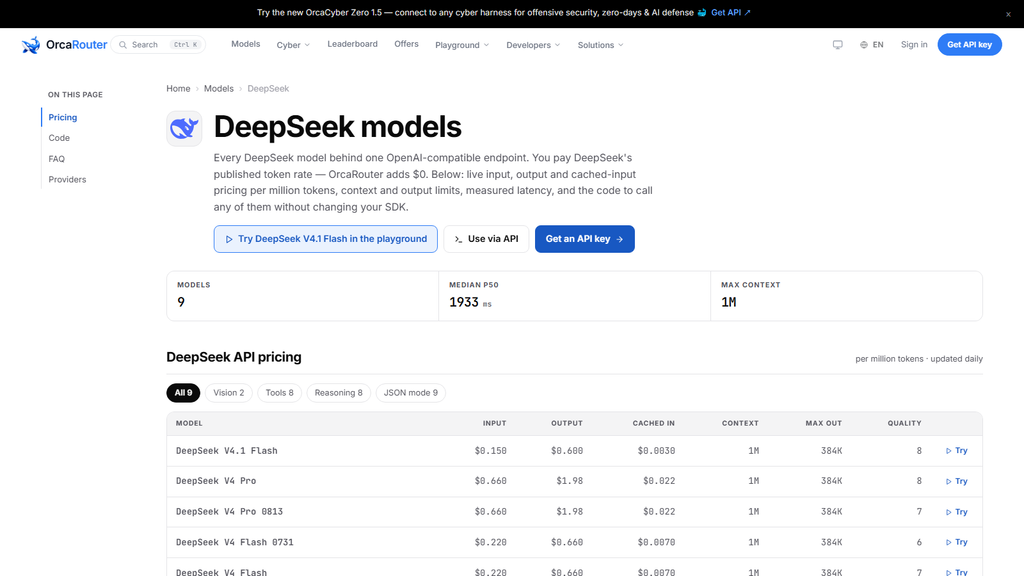
A model page that lists two prices for the same model is a budgeting problem before it is a data problem. On the OrcaRouter gateway, every DeepSeek model sits in one catalogue, and the Deepseek Models provider page carries nine rows. The flagship entry, deepseek/deepseek-v4-pro, does not agree with itself about what it costs: its STAT block says $0.66 per million input tokens and $1.98 per million output, while the body of the same page says $0.44 and $0.87, in four separate places. The catalogue table on the provider page backs the STAT figure. Two prices, one model, no reconciliation anywhere on the page.
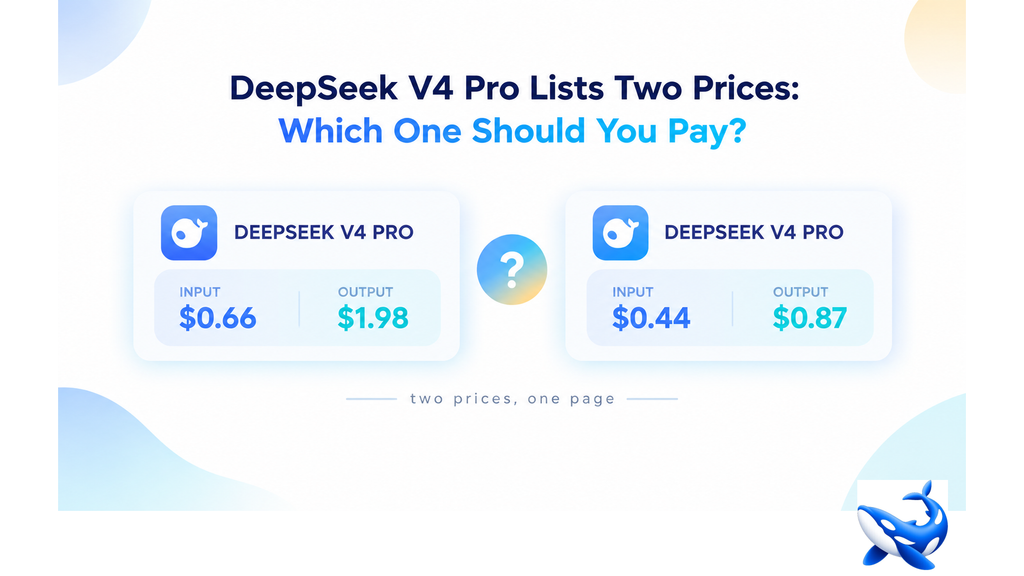
This is the kind of discrepancy you want to find on a page you do not pay yet. $0.66 against $0.44 is a 50% gap on input tokens; $1.98 against $0.87 is more than double on output. A pipeline that books one figure and is billed against the other is off by that margin every single month, and nothing on the page flags either number as an estimate. So the practical question is not which number is prettier. It is which number a reader can trust, and the page gives no answer — which is itself the finding worth acting on.
The page does not reconcile itself
The model page has a FAQ, and the FAQ does not help. It states there is no information about prompt-caching discounts for this model, which rules out the simplest explanation — a tiered price hiding in a cache column [VENDOR]. The dated snapshot row, DeepSeek V4 Pro 0813, carries the same $0.66 / $1.98 as the main row on the pricing table, so the table is internally consistent; it is the model page’s own body that splits off. A reader who quotes the model page into a spreadsheet must pick one of the two numbers and can point to no part of the page that says which one is authoritative. When a vendor’s own material contradicts itself, the safe behaviour is to treat both figures as unverified until a bill settles it.
Put the two readings side by side and the size of the gap stops being abstract. Take a workload of ten million input tokens and two million output tokens in a month. At the STAT figures that is $6.60 plus $3.96, or $10.56. At the body figures the same workload is $4.40 plus $1.74, or $6.14 — arithmetic from the published rates, not a forecast. The point is not the four dollars and change; it is that both totals come from one page, and the page never says which one a bill will follow. Scale the workload and the gap scales with it, in the same proportion, every month, until someone reconciles the numbers.
The successor is cheaper than the incumbent
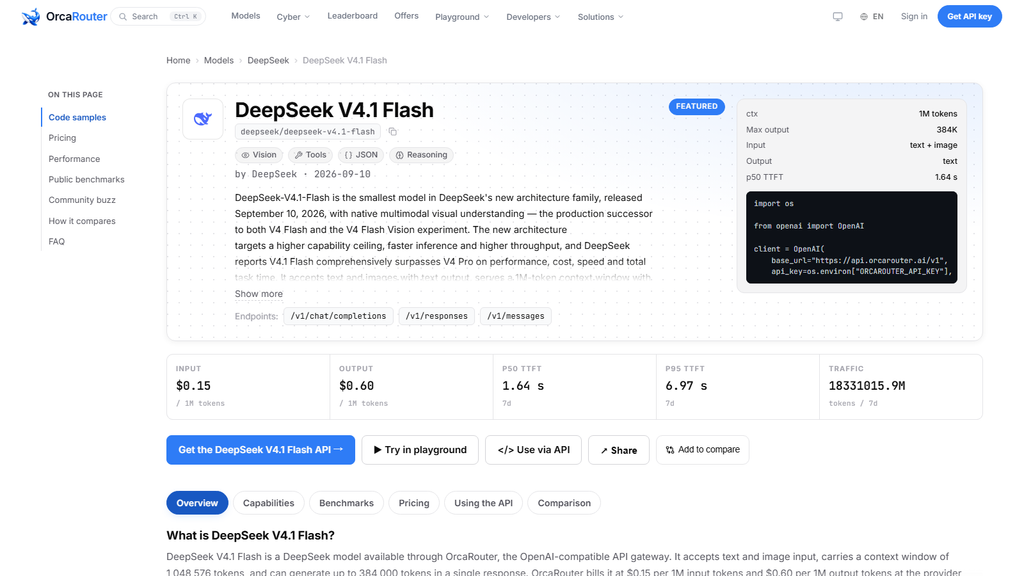
While the page argues with itself, the same vendor publishes a successor in the same envelope. deepseek/deepseek-v4.1-flash is listed on the pricing table at 1M context with a 384K maximum output — the same shape as V4 Pro — at $0.15 per million input and $0.60 per million output [VENDOR]. Against the STAT figure that is 4.4x cheaper on input and 3.3x cheaper on output. Even against the body’s own lower figures it is still 2.9x and 1.45x cheaper. And the vendor’s release material says V4.1 Flash comprehensively surpasses V4 Pro in performance, cost, speed and total task time [VENDOR]. On the provider page, OrcaRouter’s own 0–10 quality composite — a first-party score, not a third-party benchmark — rates the incumbent and the successor identically at 8 [OURS]. An incumbent that costs 4.4x more than its announced successor, with no quality-composite advantage, is a strange place to put new spend no matter which of its two prices is real.
The envelope is the part worth pausing on, because it removes the usual explanation for a price drop. A successor is often cheaper because it is smaller — a shorter context window, a lower output cap, fewer supported input types. That is not what happened here. V4.1 Flash is listed at the same 1M context and the same 384K maximum output as V4 Pro, so both models are being sold into the same slot, and the price difference is not a discount for a reduced product. Whatever the vendor’s reasoning, a reader comparing the two rows on the provider page sees one incumbent with two published prices and one successor with a single lower price and no ambiguity attached to it.
What the two model pages add
The model page for deepseek/deepseek-v4-pro labels its context window at 1,048,576 tokens with a maximum output of 384,000 tokens — the model page’s own figures, which the pricing table abbreviates to 1M. It is a pure-text model, and its p50 time-to-first-token is 1.84 seconds, with a p95 of 10.00 seconds [OURS]. The successor’s page reports a p50 time-to-first-token of 1.51 seconds [OURS]. It defaults to thinking with low, high and max levels, exposes three API shapes — Chat Completions, Responses and an Anthropic-compatible surface — ships open weights as deepseek-ai/DeepSeek-V4.1-Flash, and publishes a cache-hit rate of $0.003 per million input tokens that doubles inside the workday windows the page lists [VENDOR]. Its vendor-published benchmark scores include Terminal-Bench 2.1 at 90.6, GPQA Diamond at 90.9 and HLE with tools at 63.9 [VENDOR]. The incumbent’s page counters with a τ²-Bench score of 96.2 [VENDOR]. None of this is the point of the article; all of it is context for how strange the price table around it looks — a successor that outperforms per its own claims, priced at a fraction of its predecessor.
Which number goes into your budget
Three defensible moves are on the table. Budget the higher figure: it is the conservative read, and if the body figure is the one actually billed, you will consistently overprovision rather than overrun. Budget the lower figure and re-verify against the first real invoice: the body repeats it four times, which reads like the maintained value, but you are trusting a page that already contradicted itself once. Or route new traffic to the successor and sidestep the contradiction entirely — the same envelope, a lower published price, and the vendor’s own claim that it wins on performance and cost [VENDOR]. What you should not do is treat the discrepancy as noise. A price a page cannot state twice is the first number you should re-measure before committing a workload to it.
The tell is that the discrepancy is one-sided. A page that quotes a promotion, a regional rate or a cache tier normally says so, because the lower number is the selling point. Here the lower number sits in the prose and the higher number sits in the structured block, and neither carries a label explaining the split. Until a first invoice lands, the only honest entry in a budget line is the higher figure with a note that the page disagrees with itself — and the first thing to do after that invoice arrives is check which of the two numbers it matched.
The takeaway
deepseek/deepseek-v4-pro has two published prices on its own model page — $0.66 / $1.98 in the STAT block, $0.44 / $0.87 in four places in the body — and the page never reconciles them. Its successor, deepseek/deepseek-v4.1-flash, sits in the same 1M / 384K envelope at $0.15 / $0.60 with the vendor claiming it is faster, cheaper and stronger across the board [VENDOR]. When a page contradicts itself and its replacement is unambiguous, the cheapest decision and the safest one point the same way.
Sourcing note: all prices, context figures, cache rates and benchmark scores are the vendor’s own published figures as reproduced on the model and provider pages [VENDOR]. The model-page latency figures (p50 time-to-first-token of 1.84 s and 1.51 s) and the 0–10 quality composite are OrcaRouter’s own, measured over a seven-day window [OURS]. The 4.4x, 3.3x, 2.9x and 1.45x ratios are arithmetic derived from the published figures. No third-party benchmark figures are used. Telemetry figures are rolling and will drift. Read 2026-10-15.